
Women in STEM review “The Love Hypothesis”

By Cameron Murray
Edited by Anna Kate Mereness
On Sep. 23, Prime Video released the highly anticipated film adaptation of Ali Hazelwood’s popular STEM-themed romance novel “The Love Hypothesis.” Being a romance enjoyer and something of a scientist myself, I knew this movie would be right up my alley, but any decent scientist knows that a sample size of one is insufficient to draw any meaningful conclusions.
To address this problem, I gathered a few of my fellow women in STEM for a fall-themed dinner and watch party to see how well they felt the movie captured the realities of research, romance, and graduate school for young female scientists.

“The Love Hypothesis” follows Olive Smith, a biology Ph.D. student studying cancer, and her fake-dating-with-real-chemistry love story with professor (or postdoc, this is unclear in the movie) Adam Carlsen. The novel was originally published online as a “Reylo” fanfiction, imagining an alternate universe romance between Star Wars heroine Rey and the brooding villain Kylo Ren. The names were changed for mainstream publication, but the character appearances and grumpy/sunshine archetypes remained.
The new film, directed by Clare Scanlon and written by Sarah Rothschild, stars Lili Reinhart as Olive and Tom Bateman as Adam. A fun nod to the book’s fanfiction origins, Bateman is married to Daisy Ridley, the actress upon whom the character of Olive is based.
My panel of women in STEM included myself (first-year Ph.D. student in Ecology, Evolution, and Environmental Biology), Misaki Taniguchi (first-year Ph.D. student in Ecology, Evolution, and Environmental Biology), Zoya Bessler (public health professional), Gwynne Rohde (first-year masters student in Biology) and Allison Helferich (junior Zoology undergraduate).
Our evening began with a savory pumpkin pasta, garlic bread, Caesar salad and chocolate chip pumpkin bread. My guests had the choice of sipping on cran-raspberry juice or apple cider from the local farm store, courtesy of Gwynne, with or without fizz.
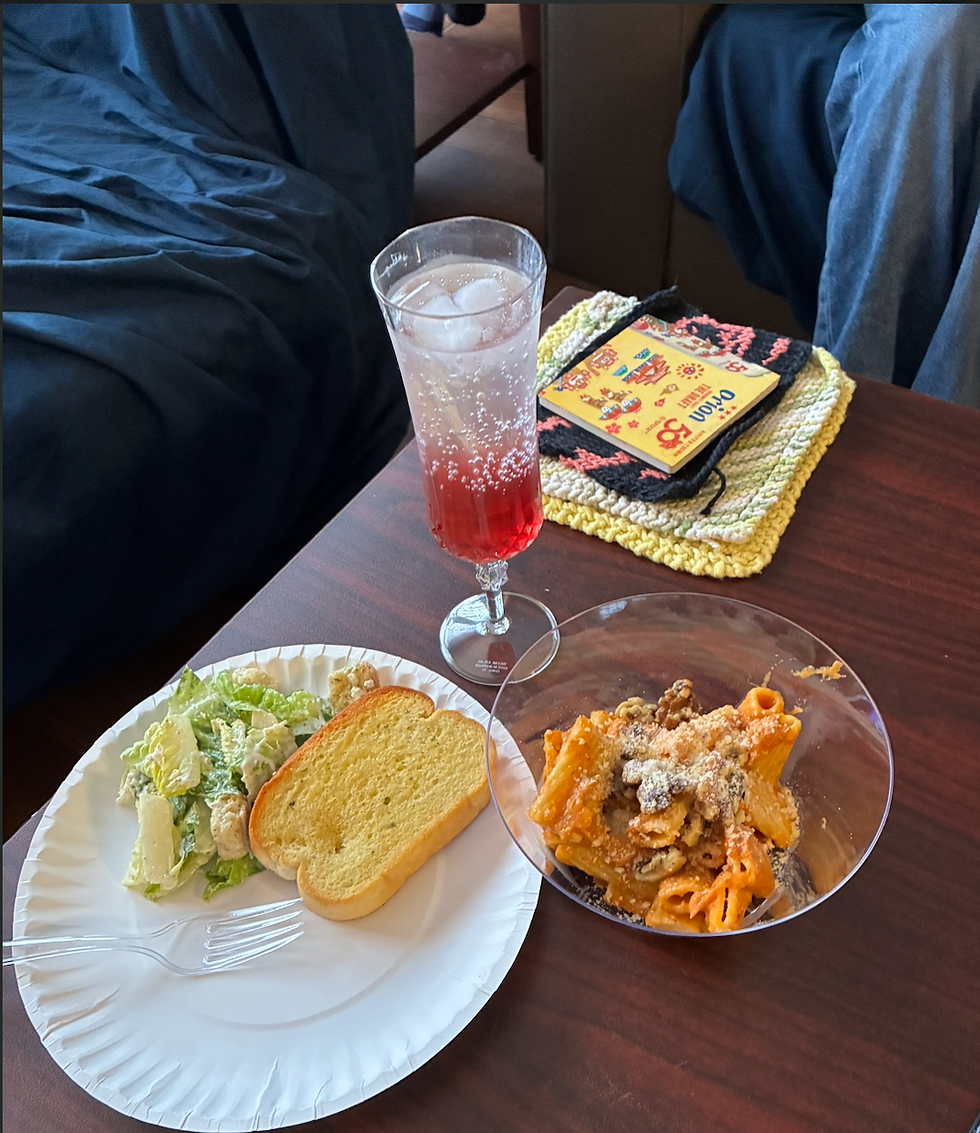
After we ate dinner and shared a few laughs, we started up the movie. We were immediately cracking jokes about protagonist Olive’s grad school experience being indistinguishable from the first day of college. Graduate school is depicted as a marathon rotation of classes, lab work, and parties. There were so many ridiculous parties driving the plot of this movie.
“I feel like they all have a lot of time on their hands,” Gwynne said.
“They have an abundance of parties,” Misaki agreed.
Let’s just get our major gripes out of the way: this movie is not an accurate depiction of science graduate programs in the U.S. It’s about as scientific as, well, Star Wars. Olive is in her third year of her Ph.D. and about to graduate, which is extremely rare in the U.S., though more common for European programs. She appears to be doing research independently without an advisor in sight. We don’t see her TA any classes, rather she appears to be taking a lot of large, basic molecular and cell biology lectures that are more aligned with sophomore or junior undergraduate classes. Olive’s friend and roommate laments his parents not having money for tuition, but reputable research-based Ph.D. programs should be fully funded, especially at a place like Stanford.
It was also unclear what career stage love interest Adam was meant to be at: he’s referred to at multiple points as a post-doc, but we see him running a research group and terrifying students, responsibilities usually reserved for professors. A postdoctoral researcher has completed their Ph.D., but still works under the mentorship of a more senior scientist for additional training and experience. By definition, these positions are temporary, so the rom-com logic reason for Adam to fake-date Olive doesn’t make sense if he’s a postdoc. Why would any post-doc not be considered a “flight risk?”
And of course, the elephant in the room: the plot is a series of absurd HR violations. Misaki joked that they should show the movie in workplace harassment training, pausing at pivotal scenes to show a slide asking “what should you do in this situation?”
Despite all this, we were eating it up. “The Love Hypothesis” is nothing if not entertaining. Skeptics though we were, we did find ourselves reluctantly rooting for our main couple to admit their feelings.
“That would be so tea to witness,” Gwynne said about a later scene.
“The department group chat would go wild if this happened,” Misaki said.
“The Love Hypothesis” also highlights some of the struggles women in STEM might experience in real life. Olive suffers from imposter syndrome, has trouble speaking to groups about her research, has her intellectual merit questioned by others, and even experiences the betrayal of quid pro quo sexual harassment. The execution was a little reminiscent of a “very special episode,” but I appreciated the acknowledgement of these issues and felt that the way they compounded to damage Olive’s confidence was very true to life.
What makes “The Love Hypothesis” a cut above similar direct-to-streaming romcoms is its protagonist. Olive Smith, much as she made us yell at the screen, is just plain likeable. She perfectly encompasses the eternally self-deprecating, overthinking tendencies favored by graduate admissions, as well as the wide-eyed wonder and pure love of science that pushes scientists to put up with the stress of academia. Lili Reinhart plays her so earnestly, without the bitter irony that drips from most grad student characters we’ve seen in movies before.
“It’s so rare to see a less outgoing female lead,” Zoya remarked.
Our consensus on the movie was that it’s science fiction, and it is not a good idea for professors and students to date, but that it was cute and we had fun watching it together as friends.
In the end, if Olive Smith can be for young women interested in pursuing science what Elle Woods was for a generation of women interested in the law, then I’m glad that “The Love Hypothesis” exists.


Comments